
AIMS Program: What Happens When I Report Incidents and Near Misses?

The Assurance and Improvement in Medication Safety (AIMS) Program puts in place a mandatory consistent standard for medication safety for all pharmacies in the province. Its goal is to support continuous quality improvement (CQI) and to reduce the risk of patient harm caused by medication incidents in, or involving, Ontario pharmacies.
One of the requirements of the AIMS Program is that pharmacy professionals must report all medication incidents and near misses. As of January 1, 2027, pharmacies must use an incident management platform that meets the College’s criteria and provides daily uploads to the National Incident Data Repository for Community Pharmacies (NIDR). The College maintains a recognized list of platforms that have successfully completed testing for data submission to the NIDR and have an executed agreement in place with ISMP Canada. Several platforms are currently undergoing testing for NIDR data submission.
This article highlights the importance of reporting, how it supports learning and improvement, and who can access the reported information.
Why Is Reporting Important?
Reporting medication incidents and near misses through an incident management platform supports learning and improvement by helping identify recurring patterns, contributing factors, and system-level issues that may need to be addressed to prevent future occurrences. Aggregated data also allows pharmacies and organizations at the regional, provincial, and national levels to establish a baseline, identify trends, implement targeted changes, and measure improvements in medication safety over time.
By requiring consistent information to be captured for each medication event, incident management platforms enable the collection of reliable and actionable data for analysis.
Reporting is only one component of the AIMS Program. Other key AIMS components, including documenting, analyzing, and sharing lessons learned, must also be completed to support continuous quality improvement. These actions help pharmacies identify opportunities for change within their own practice, which can be further strengthened by insights and learnings from provincial and national data.
How Does Reporting Support Learning and Improvement?
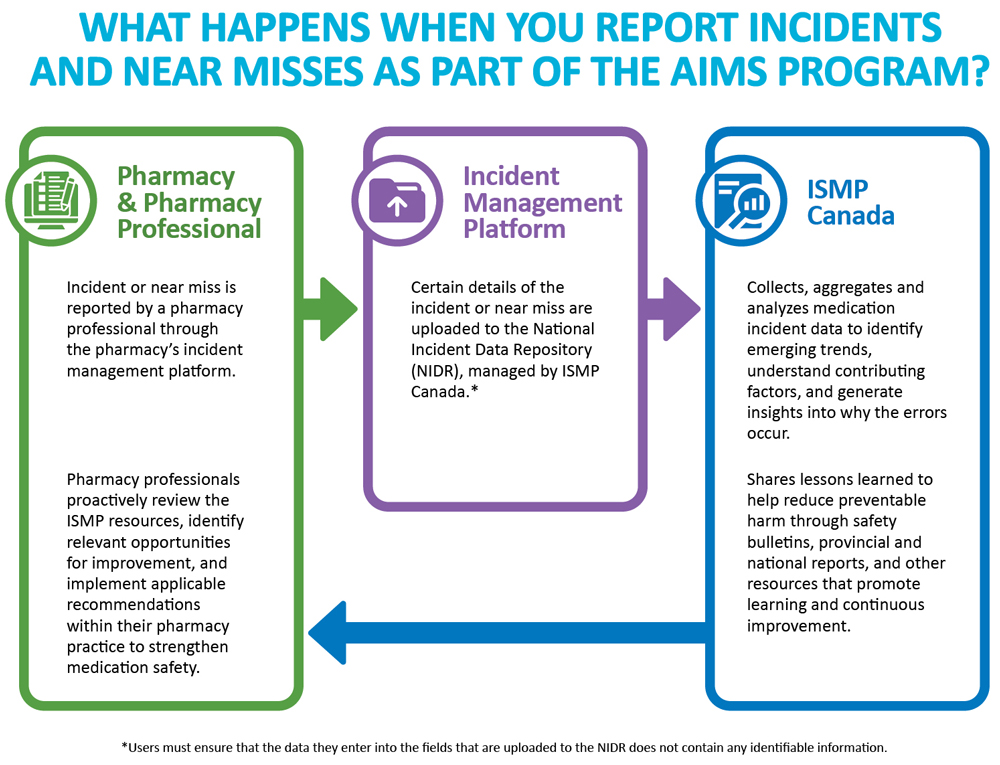
A pharmacy professional enters details about a medication event into their pharmacy’s incident management platform. Selected data elements are then regularly submitted to the National Incident Data Repository for Community Pharmacies (NIDR) to support broader learning and improvement.
The NIDR is managed by ISMP Canada, which collects, aggregates and analyzes the medication incident data to identify trends, understand contributing factors, and generate insights into why safety issues occur. ISMP Canada shares lessons learned and recommendations to help reduce preventable harm through resources such as national snapshots, provincial safety briefs (Ontario will be added following 2027), and safety bulletins.
Pharmacy professionals are expected to proactively review ISMP resources and implement applicable recommendations within their pharmacy practice. Quarterly continuous quality improvement (CQI) meetings provide an opportunity to discuss relevant resources, identify opportunities for improvement, and support the implementation of changes within the pharmacy (see the CQI Meeting Sample Agenda).
Who Can Access Reported Medication Event Information?
ISMP Canada manages the NIDR and has access to the data submitted to the NIDR for the purpose of aggregating, analyzing, and generating medication safety insights.
The College does not have access to individual incident management platforms, or individual medication event reports submitted by pharmacies. The College cannot identify individual pharmacies or pharmacy professionals involved in specific medication events reported through the platforms.
The College will receive aggregate information from incident management platform providers and ISMP Canada to support oversight of the AIMS Program and monitor progress in medication safety improvement. In addition, the College will receive confirmation from incident management platform providers regarding which pharmacies have enrolled with their platform.
Resources to Support AIMS Program Changes
Several resources are available to support implementation of the upcoming changes: