How Swiss Cheese Can Help Visualize Medication Safety Risks

February 2026: This article has been edited from the original to reflect updated information on AIMS and remove information on Quality Indicators.
Learning from medication safety incidents and near misses is an important part of reducing the risk of patient harm. And one of the best ways to identify and address the root causes of medication errors in a pharmacy is through a process of continuous quality improvement (CQI).
When a medication safety incident occurs, it often has multiple causes—a series of mistakes, oversights or system failures that combine to create risk for a patient. This type of medication error can be visualized with the Swiss cheese model of system accidents[1].
Imagine several slices of Swiss cheese, each representing a different layer of human, technological or system safeguards in your pharmacy. Each layer has holes that reflect the inherent weaknesses in that particular safeguard. Normally, if one hole is penetrated, another slice (or safeguard) stops an error in its tracks. But what if the holes suddenly lined up? Now it’s as though there are no safeguards at all.
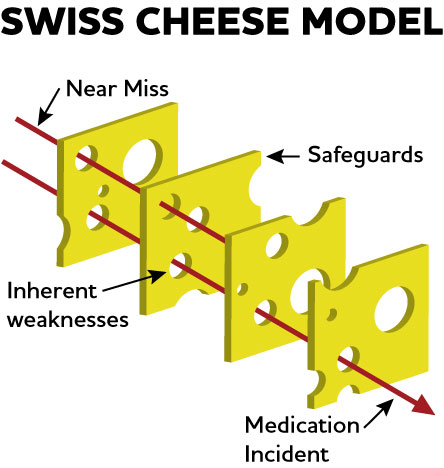
Click here to read a text-only explanation of the graphic above
The point is, no matter how many protections are put in place, there still exists the potential for a medication incident to occur. This highlights the need for continuous evaluation of a pharmacy’s risk mitigation processes to ensure safeguards and systems are effective and adaptive.
Assurance and Improvement in Medication Safety (AIMS)
To support its mandate to serve and protect the public, the College’s Assurance and Improvement in Medication Safety (AIMS) Program sets expectations for pharmacy professionals regarding the assessment of potential areas of risk in a pharmacy’s workflow, along with tools to assist in extracting actionable learnings from incidents or near misses that do occur.